
Velozity needed an API that could accept recorded data from an ECG machine, analyse the signal and return structured information about the heartbeats and potential arrhythmia patterns present. Impact developed a PHP/Laravel processing service combining digital signal processing (DSP), waveform measurements and configurable rhythm-matching rules.
From ECG samples to a usable API response
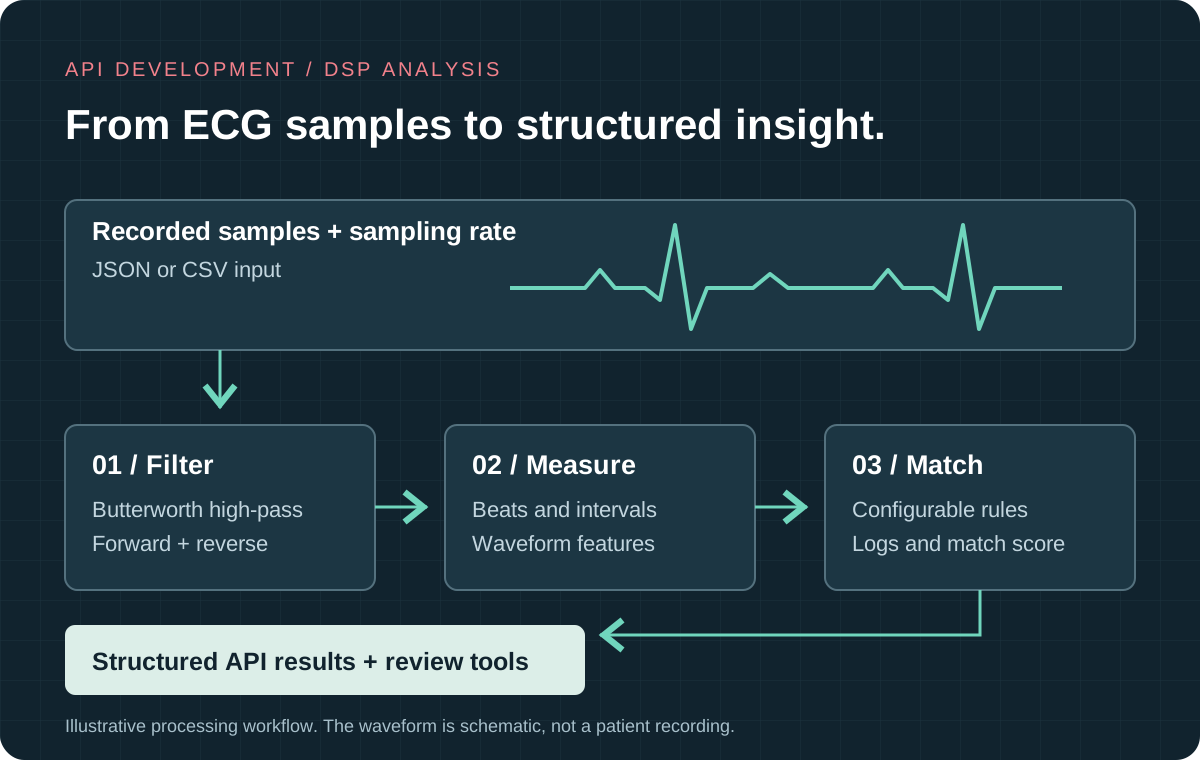
The API accepts ECG sample values and their sampling rate in a JSON input, alongside an upload route supporting JSON and CSV recordings. Preserving the relationship between samples and time is fundamental to the implementation: the processing service uses the sampling rate to calculate recording duration and waveform timing measurements.
Applications receive structured results containing recording information, beat counts, minimum, maximum and average heart rate, per-beat measurements and rhythm-analysis output. This makes the analysis available to another software system through an interface, instead of confining it to a standalone demonstration screen.
Digital signal processing before rhythm analysis
The processing pipeline includes a Butterworth high-pass filter applied in forward and reverse directions. This filtering stage addresses baseline drift before the code locates waveform features and builds beat measurements. The implementation also records intermediate data for inspection, allowing developers to compare the incoming signal, filtered samples, waveform candidates and detected beats.
Rather than treating the waveform as an undifferentiated series of numbers, the analysis works with the shape and timing of candidate features. It identifies beat structure and calculates measurements including R–R intervals, QRS duration, P-wave characteristics and PR and QT intervals. Configurable settings and tolerances support the development and refinement of those processing steps.
Configurable rules for potential arrhythmia patterns
The rhythm-analysis stage compares measured characteristics with stored rhythm definitions. Checks include rate, regularity, interval ranges, P-wave presence and morphology, and the relationship between P waves and QRS complexes. The service records which checks matched and which failed, returning the selected model, associated tags and a rule-match score.
This is a rules-based signal-analysis implementation. Its match score describes the proportion of configured checks satisfied; it is not a clinically calibrated probability. The reviewed implementation identifies itself as an alpha version, so this case study describes the development work rather than claiming a clinically validated diagnostic product.
Tools that make specialist algorithms inspectable
Alongside the processing endpoints, the project provides interfaces for listing and inspecting rhythm models, updating model definitions, reviewing settings and examining response-object structures. A browser-based graph view overlays the original and filtered signals with detected features and beat markers. CSV outputs and processing-stage timings help developers inspect the analysis and investigate individual recordings.
These capabilities matter when developing a specialist processing service: the team needs to understand how a result was produced, compare behaviour across test inputs and refine the implementation with domain experts. Impact's work connects that analysis code to practical API and review tools.
API development with deeper engineering behind it
This project demonstrates the combination of skills needed when an API must do more than transfer records. It joins input handling, time-series processing, digital filtering, waveform feature extraction, configurable decision rules and structured output within a single application.
- Connect specialist equipment data: give another application a defined route for submitting recorded samples and receiving analysis.
- Reuse the processing capability: separate the analysis service from the interface consuming its results.
- Make results traceable: return measurements and matching logs alongside the selected rhythm model.
- Support technical refinement: inspect intermediate signals, adjust model definitions and compare outputs during development.
For businesses working with instrument data, sensors or other sampled signals, Impact can bring bespoke API development together with application engineering and DSP analysis. Explore our industrial monitoring software for BOBST, Cadtracker embedded tracking prototype and other API integration projects.
Discuss your API, instrument-data or signal-processing project with Impact.